
 November 6th, 2008
I'm often amazed at our natural ability to handle information. I know that we make a big deal out of google's ability to find things (and it is a bit deal). But our natural ability to contextualize, and just as crucially to hide information, is unlike anything man has built so far. Just imagine what would happen if your brain showed you all the information it has, spread across the living room floor. You would not only completely forget what you were doing, you'd also never be able to find anything ever again.
We have tried to emulate this contextual ability through what we like to call modes, or profiles, or presets. Fancy cars have the ability to tune the ride either for speed, or for comfort. Digital watches have modes of operation, so when you want use the stopwatch all the other displays vanish and you're in stopwatch mode. The idea is that you change one setting, the mode, and that triggers a whole range of sensible contextual settings appropriate to that mode.
There is definitely a lot of modal functionality in our visual perception. For instance, we can't perceive a very wide spectrum of luminosity, so when you go into a dark you room your eyes need to adjust. And in that mode, if you look at something very bright, it will blind you. You won't be able to see anything else. Another example is the way we see patterns. Most of the time, when you have your eyes open, you see the same level of detail all the time. It might be interesting to ask whether your eyes might be seeing more than your brain decides to "show" you. Again, hiding unnecessary information is valuable. But if you really look closely at something, even from the same distance, you begin to notice things that your "regular" vision doesn't see. Little details appear, details that are not generally "important" to the way you look at it, but since you've switched to detail mode, you now see them. Patterns in the material, shadows on an uneven surface, spots where the material is scratched.
I like to call this mode the cleaning eye. Have you ever noticed that when you start cleaning everything looks different? The cleaning eye is one particular mode that has to do with analyzing the surface and spotting things on the surface that are not part of the surface. We are not very sophisticated at this, there is one way to make a determination. It's called the cleaning test. Try to clean it, and if it comes loose, it's dirt. If it's dirt, then you know that everything else on this surface that looks like that is also dirt. This test can give misleading results. (Have you ever used a cleaning liquid that was too potent, and you ended up damaging the surface you were supposed to be cleaning?)
What's interesting to me about the cleaning eye is the emotional responses that go with it. There are two opposing forces. On the one hand, you want to spot dirt, because that's the only way to justify what you're doing. Why am I cleaning this, there's nothing to clean here, what a waste of time. But once you switch to cleaning mode, it doesn't take long before you find dirt, no matter how clean the thing is. So you start cleaning, and once you exhaust the supply of dirt, you move on to another area.
Now comes phase two. Your eyes have been focused on finding dirt for so long that you start noticing that in this new area there are spots of fine dirt that you didn't notice before. You think to yourself huh, that's weird, I didn't see this in the first area I was cleaning. So you go back, and suddenly, there it is. You got the big, obvious specs of dirt, but you missed these smaller ones. Now you have to make a decision. Do I ignore this, and hope that noone else will notice it either, and I'll be in the clear? Or do I do a thorough job and clean as much as I can?
Let's say you choose the latter option. So you're cleaning and it's really getting boring, cause there is so much more fine dirt than there is obvious, big dirt. Emotionally, there is no satisfaction from cleaning, because the more you clean the more details your eyes find that you didn't see before. Once you get rid of the really fine dirt and move on, you invariable notice you missed something over here. And over there. And everywhere.
In theory, the process of cleaning proceeds until there's no more dirt visible. But you'll never get there, because there's always more dirt, smaller dirt, or dirt that won't come off easily. You could clean your bathroom until it's completely pristine, and spend the whole weekend doing that, but would that really make you happy? In a week there will be dirt again, and in a month the dirt will be visible on a regular basis. All this time and effort you spent one weekend, and for what?
The truth, of course, is that it's impossible to get anything completely clean. You would have to actually remove all the molecules that don't belong.
So at some point you reach your limit. That's enough, I'm sick of cleaning. You stop cleaning, you sit back and relax for a minute. You're not feeling happy, because you know there is still more dirt over there. But how long can you go on cleaning? Alright, forget it. Your mind drifts off to something else you'd rather be thinking about. Cleaning starts to fade in your mind. Fifteen minutes later your mind is completely occupied with something else.
Now something interesting happens. Someone goes into the bathroom. Wow, it is really clean in here! Woh, what? You go in yourself. Hey, look at that, I don't remember the last time it was this clean. Interestingly, the pay off comes not from cleaning "until it's clean", but from giving up on it. You switch from cleaning mode and stop using your cleaning eye. Now the image before you is contrasted with the way you remember the bathroom, and you see the difference. Hey, it looks clean.

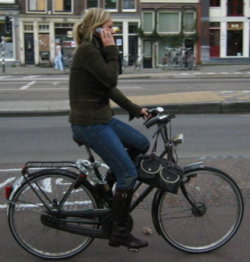 You might think "Hey the Dutch are nuts about biking, I bet they have great bikes over there!". You'd be wrong. The bikes in use in this country are something out of an old Soviet factory. Single speed, pedal brake, black paint (or painted a bright color to conceal rampant corrosion), with a regular chain for locking. Often you can hear them coming, wheels spinning unevenly on the axle because the rims are slightly bent, lights fastened poorly and about to fall off, crank screeching against the panel that conceals the chain. Not surprisingly, bike repair is a thriving business in this country, repair shops are everywhere.
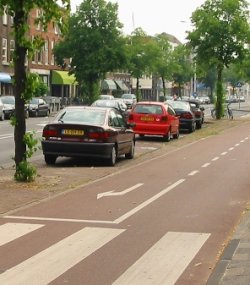 Then there are the bike lanes. Yes, they are dedicated to bikes, and yes they are separate from motorized traffic. What you probably don't expect, however, is just how boring it is to ride on them. They are completely flat, they have their own traffic lights, and even indicators for traffic going in different directions. It's no wonder bikes don't have any gears, there's no way you could build up any speed before you have to stop at the next light. It is the experience of urban biking with the added bureaucracy of driving a car