Archive for the ‘english’ Category

the mentality of a linux user

August 26th, 2004

It occured to me today that going from the Windows world to the Linux one is quite a leap in mentality for most people. Much has been said about this but I write this now to emphasize the differences I have seen myself.

Generally speaking, Windows is a playground. I used to install all kinds of software I didn't need, just to try it and see if I could use it. Sometimes I would find a use for it, sometimes I would use it no more than ~twice a year. That was a pastime at some point, accumulating software (mostly shareware) was some kind of a hobby. Of course, that wore down and I started just getting stuff I needed. But that initial need to explore software I think had much to do with the lack of opportunity given by Windows to mess around with the system. Of course you have specialized software that tweaks system settings and the registry but what fun is that when you don't know what really happens anyway? And often there's no way to tell either, you see the difference or you don't.

Stepping into linux with that attitude, there were a number of pitfalls I encountered. First of all, reading docs/manuals in linux is *not* time wasted. Reading install documents is actually preempting trouble, I learnt this only after I had tried installing the same software several times not knowing what I was doing or why. I wasn't keen to find out what exactly was going on, I just expected it would work fairly quickly so that I could mess around with it once it was running. Not so with linux, gaining a basic understanding of the install process goes a long way towards solving the problems that come up (well duh). Being a new user (still), I still find it unnatural to dive right into docs and logs but it grows on you. As it turns out, system logs are incredibly useful (who would have thought?). Often dismissed for their obscurity and lack of obvious messages understandable to dumb users, I now begin to realize their value. It is much like learning to speak a foreign language, at first it's all a blur, then you start identifying basic words and phrases. Exactly like reading logs or documentation!

Getting around the system is a big problem, at first I had no idea where to look for what. I suppose I could have read all about the philosophy behind the unix file structure but instead it just became familiar with use (slowly by steadily). Most intuitive is the problem of installing software, where do the files go? Stuff like qpkg really help a lot to track those files. Apart from location, it's also about access control. As a Windows user, I never had to think about gaining access to a file because by default I could access all files. The only exceptions where those really annoying system/driver/trojan dlls that were currently in use and locked on disk. Well linux doesn't operate on file locks, instead you surrender your access rights to the root user. And running as root I think is a very useful learning experience, cause I *really* hated getting those access denied messages all the time as a newbie. Hopefully you won't wipe your / with windows partitions mounted in the process, I have yet to do that myself.

Another thing forced on you is being a lot more intimate with your hardware. This is something I could do without because I've never been a hardware buff. But I've gotten used to it, the first order of business is identifying the hardware and googling for drivers. Sometimes getting those working can be a challenge but most of the time it's worth the effort. In the long run, better auto detection could really help make this problem go away to the casual user.

So those are 3 things learnt from linux:

1. reading docs and logs

2. file structure and permissions

3. hardware awareness

why napping isn't an olympic sport

August 24th, 2004

I think quite conceivably, many of us these days comfortably seated in front of the idiot box, watching the Olympics, feel that our side is not represented, none of the activities we participate in daily have found a place in the grandest sporting event known to man. There is no pie eating contests, no cross country shopping, no bar brawling. A large chunk of the population is sidelined, as far as their ambitions and dreams are concerned. I'm here to make the case for a wildly popular activity among the masses, I'm also here to explain why it never made the cut.
We're all very comfortable and familiar with sleep, it's often what gets us through the day when all else fails. Sleep is a healthy, wholesome activity in which we engage with enthusiasm. Given how often we practice it, everyone of us would be eligible for a tryout for the Olympics. But most impressive, no doubt, are those who can sleep through very long periods of time. I don't have the numbers on me but I imagine the official world record for sleeping at length is a very impressive one.

Thus the case is made, napping would be a natural addition to the highly acclaimed Olympiade. So why is it missing? Well, unfortunately the noble sport of napping has certain practical inconveniences. For instance, it requires very knowledgable and dedicated, not to mention enduring, commentators. Imagine a 34h napping event, how many cups of coffee, buckets of water and slaps in the face would that command? Quite a few. Secondly, the sport would require highly sophisticated equipment to determine a contestant's physical state. Faking sleep is, of course, very trivial. So it would require sensors for monitoring brain activity and the works. Hand in hand with blatant cheating goes the issue of doping. For an unrestricted event, the organizers could distribute sleeping pills and simply award the medal to the contestant who slept the longest but still woke up. Otherwise a lack of pulse would be awarded with disqualification.

So there it is, sports fans, the reason why our beloved sport will never be cheered on by the masses, why our athletes will never receive the glory their skills deserve.

iRobot

August 7th, 2004

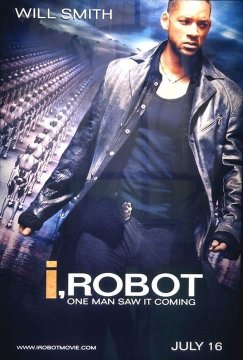
iRobot I was fairly skeptical, I mean Men in Black and all I thought this was gonna be a forced sequel to that series. But it's not, in fact it's a decent movie. What surprised me the most was the story being interesting and it made pretty good sense, which is not something I can say for most movies seen these days. The idea of Sonny passing on the message is a good one. The world of robotics stands on its own to feet in this one, it actually makes me believe the story. What a refreshing change! Obviously, Will is still being Will :cool: but it's less about him this time and more playing towards the story.

The movie also has a few other strong points. First of all, those cars were very cool, taking Audi TT to the max, I like that idea. Then the motorcycle racing was done well, the sound effects, closeups, very enjoyable. Then there's the fight scenes, which I think were done very well. Violence towards robots, that's quite an ingenious concept, it's a victim less crime. ;)

But no review would be complete without pointing out some apparent flaw. Isn't it a little curious how easily they found out that VIKI was the mastermind behind the revolution? I mean the whole building was built around computers but isn't it a little suspect that there's just one computer controlling everything? Wouldn't it make more sense to have various systems doing specialized things? I mean the whole one system controls everything is such a predictable conspiracy concept. Or is that supposed to be the beauty of it?

8/10

when does it end?

August 3rd, 2004

It must have been about 15 years ago when the madness struck in Norway. 10kr became 9.95, 100 became 99, 1000 became 999. I would like to know which moron came up with this ingenious sales gimmick. It clearly has stuck, because after so many years it's still around. But is there a documented case of even one customer who fell for it? I find it hard to believe that any sane person, with or without the basic grasp of arithmetic (but with a working knowledge of how currency works however, in as much as the two can be separated), would fall for this trick.

It's obviously not a discount, because that would involve lowering the price by a distinguishable amount. Instead, we pay 9.95 instead of 10, which is a bipolar aggravation. Firstly, if you don't have the change, the cashier will still customarily ask you for it. Secondly, not having the change means you are getting it with every purchase. And it doesn't take a financial analyst to realize that the change we are walking around with is worthless. It's not enough to pay for anything and if you want to actually spend it, you have to keep saving up for some period of time before you have enough. Unless you keep it around for the sake of that cashier, if you give them change, they will reward you with a bill. But then you do need change in the first place to complete that transaction and walk away in satisfaction. So there is no getting away from it.

But the question remains, what is the purpose of this annoyance? And if there actually is a purpose for it, perhaps it's now, 15 years later, safe to say that it's outlived its function? Wouldn't we all be happier going back to paying 10? I would like to see a store open with that motto, we don't give you change. Everything costs a full amount, 10, 20, 50. No more change. I think it would be a tremendous success.

walking etiquette

July 29th, 2004

I don't think many people give much thought to walking, it's such a simple, straightforward activity that there's not much to it, on the surface at least. Yeah, that's until you encounter people with poor walking etiquette. They come in all shapes and forms. Most distinct are those who walk too fast or too slow for you to keep up. Somehow they are oblivious to the fact that different people may enjoy different speeds of walking. It's mostly the fast walkers who do this, if they looked to the side for a minute they would see you taking giant strides trying not to fall behind. But even if they look, it's one of those disapproving looks, could you pick up the pace a little bit you think? The fast walkers are easily identifiable, they always have a purpose to their walking. These aren't the people who go window shopping, no they keep their eyes fixed on their destination. No change of course being made here. Time is money.

On the other side of the equation you have the slow walkers. And this isn't about physical ability or endurance, these people just refuse to speed up no matter what the situation is. It's like going faster would conflict with their religious beliefs, it's not being done. And sometimes you need to pick it up a little, when you have to get somewhere on time. These people never worry about getting anywhere on time. Whatever happens happens. 8 or 8.30, what's the difference anyway? And they are so attached to this notion of never doing anything quicker than they normally do at their casual pace that it's downright hard to shake them. Only a serious threat of missing out on something, or better yet facing a penalty for being late, will sway them from their comfortable path.

Too fast or too slow, that's fairly obvious all things considered. But that's not all, there are certain variations of these trends. For instance, there are people who tell you they can't keep up with you. But instead of stopping or slowing down, like any rational person would expect, they walk at the same speed you do, only 2m behind you to prove their point. Not surprisingly, this doesn't work cause if you can walk at my pace, walking behind me is just a question of displacement, not velocity.

More annoying yet are people who refuse to align with you for any reason at all. If you're walking for more than 30 minutes, inevitably at some point one person will stop for some reason. The excuses are many, tying shoelaces, looking at something you pass by the road etc. Now what would good etiquette entail? Nothing more than slowing down or better yet waiting for that person. It's not rocket science after all. But some people never do that, if you stop you have to race back to catch up with them. And even if you try to influence them, very suggestively stop when they stop to show them how it's done, they don't care. Yes, I see that but I'm not interested. And these people generally don't care about alignment at all. If you stop and don't catch up with them, they will keep walking. Similarly, if they stop and you don't wait, they don't catch up either, just carry on at their own pace.

That is a strange phenomenon. If you're supposed to walk with someone and they have to stop for something, you keep walking and they're too stubborn to catch up with you, then you just end up walking at the same pace several meters apart. Apparently, some people don't see anything wrong with that. And it's too embarrassing to have to point that out, it's just walking after all.