Archive for 2007

tv shopping is here to stay

September 12th, 2007

I used to watch a lot of tv when I was a kid. One thing that was very common was for stations (cable stations especially) to broadcast tv shopping in the off hours. I recall TV3 did this a lot, they called it "teleshop" I think.

What strikes me is that not only has this home shopping gig not worn out yet, it hasn't even changed at all from the early 90s. And that's a bit unusual, because so many practices have been forced to evolve or become deprecated. But this tv shopping has survived. Why is this? Do they actually sell those products? Hard to believe, isn't it? I've never bought anything. In fact the very "exclusivity" of the products, how you "can't buy them in any store" raises a serious credibility issue with me.

And the funny thing is they still sell the same things! In the 80s/90s there was a well established stereotype, at least in Norway, about vacuum cleaner salesmen who would come to your house and try to demonstrate the product for you. This was a solid reference for jokes and humor programs. A bit I've seen many times is a person answering the door and before the caller has a chance to say what they want you say "no, I don't want a vacuum cleaner" and slam the door.

And yes, in the 90s they sold vacuum cleaners on tv. This is how it would go. First of all, the studio looks like one of those kitchens they used to give away for prizes in game shows. It's clean, it's very big, no dishes or kitchen ware in sight. There are two hosts. One is the product expert, who is going to demonstrate the product. The other is, usually a woman, the person who is going to exclaim amazement at every detail. They start off with a side-by-side comparison of the product on sale with some other "typical" product. So they make a mess on the floor, and the "expert" tells the woman to clean it up . She tries, and, of course, fails. Then the expert uses *his* product and it goes very well. She's very impressed. Then he starts enumerating the virtues of the better vacuum cleaner, to her wide eyed disbelief.

After that's done, he launches into a sales presentation. This is how much it costs, but we're giving everyone the special discount (which is perpetual) and so you will only pay this much. Plus shipping. And we're giving you these bonus items just because we're nice. And if you order within 10 days you'll get a complimentary cheaper-product-also-sold-on-tv. You can't beat that deal.

Then comes the black and white sequence. A woman (a different one) is shown vacuuming and she's holding a hand to her back, which means her back hurts. She's also doing a poor job of cleaning, as she misses spots here and there. This is you. It's shown in black and white to tell you that what you're doing is arcane and obsolete. And silly. Seriously, wisen up and buy this product. And now comes a repeat of the sales pitch again, without any people this time, just filming the vacuum cleaner, all the extensions you can put on it, and the special price. And the bonus gifts. And finally the list of countries and telephone numbers to call.

And if you turn on the tv today in the off hours, you'll see very same thing. The same kind of studio, the same people, the same lines, the same sequence of scenes. It's like archival footage. And they *still* sell vacuum cleaners. Now they've abandoned vacuum cleaners in the traditional sense, so they sell mops and things that clean with steam and what have you, but it's the same thing.

But how much can a vacuum cleaner really do for you? It makes cleaning easier, but it won't make you happy, will it? I like the products that make you a better person. Like pills that give you more energy, and dietary products, and skin care. It only takes a clever person to make a better mop, but it takes a doctor to examine and approve a chemical that's going to be sold to the public. If you're a doctor you can be the star on tv shopping. They bring you out, you get applause and admiration. Then you have to explain how the lotion works and why it's so fantastic. Be careful to inject some pseudo scientific terms to sound like a credible scientist. And you have to wear a white lab coat and a stethoscope, like you just came off duty at work, because who in their right mind would believe a real doctor would come on a program like this?
head on collision with a bicycle

September 11th, 2007

I had a rather unfortunate happening today. I was leaving the supermarket, which is on this narrow, but busy street (too narrow for its needs, as the case often is here). I had reclaimed my bicycle from the over crowded bike stand and I was about to get on it. I had a loaf of bread in my left hand which wouldn't fit in my backpack, so my movements were a bit impaired.

Now this street is only wide enough to allow one motor vehicle to drive, so if there is a car coming in the opposite direction, you have to basically look for a space to squeeze in so you can pass each other. And there's normally quite a few cars on the street. On both sides you have these concrete poles every 2m to draw out a narrow sidewalk for pedestrians (but which is level with the street).

As I was making my way out, there was a van parked right up against the bike stand, which blocked my view in the direction I was going. On this street that's quite common. So just as I mount my bike and push off, I see around the van and there are two bikers coming at me at 3m away. Oops. I was too far out to pull back in behind the van, and it was too late to speed off as well, so basically I was stuck. Terrible timing. A woman rode the first bike, probably 40ish, the other biker was a bit behind. She hit the brakes and stopped just so her front tyre lightly bumped into my front wheel. An inexcusable traffic blunder on my part.

She came to a full stop, I was relieved. The other bike just behind her also stopped. I look up at her. She gives me a stern, but somewhat understanding glance. Says nothing. I say "sorry" and take off. This is the way people are here. Calm. Patient. They've figured out that getting mad doesn't do you any good. I forced her to come to a complete stop. Very annoying. But ultimately harmless, and nothing to get all riled up over.

But these are the kinds of blind spots we have. On my bike I maneuver just fine. Two minutes after the incident I caused a kid a bit of mild panic when he thought I was making a turn just in front of him and he was going straight. Of course I could see I would make my turn well before he could crash into me, so there was no risk. But these are the things we don't think about. On the bike, fine. But while getting on the bike with a heavy backpack and one hand not fully available, reaction time increases.

recover lost stuff from memory

September 10th, 2007

This has happened to you before. I'm painstakingly typing a long email on gmail and I'm not sure that I should send it yet, cause it feels like I'm forgetting to mention something. So I want to save it as a draft so I can finish it later. Somehow I hit Discard instead. :doh: Gmail flashes the notice your message has been discarded, but I don't usually read those messages, so I navigate away from the page, and *just* as I click the link the meaning of the message dawns on me. Shit. Now it's too late to undo the action. Son of a. :fero: :wallbang:

Okay, relax, perhaps all is not lost. A couple of weeks ago I went over how you can find stuff on disk by searching the raw data. The same *can* be done with memory. See, just because my message is gone and gmail doesn't display it anymore doesn't mean it's not still possibly somewhere in memory. It just isn't being displayed anywhere.

There are two ways to access physical memory. The two interfaces are /dev/mem and /proc/kcore. As root, you can read from these. (However, if you try writing to them you'll probably mess up your system.) They are not identical, and it seems that /dev/mem doesn't let me access memory above 896MB (High Memory Support in linux kernel parlance), so just use /proc/kcore.

To find that lost message in raw memory, it helps if you can remember a phrase from it. Then do

cat /proc/kcore | grep -a --color -C1 "a phrase from it"

This will search the memory treating it like text, and highlight the phrase when it's found. It also prints "one line" above and below the line where the text was found (although considering this is binary data, the notion of "a line" is somewhat diffuse). Anyway, you probably now have enough context to get your whole message. If not, increase it to -C2 and so on.

This way I was able to recover my message. :party:

In principle, you can also recover lost files this way, provided they are still in memory, but searching for binary data within binary data is a bit trickier, so it would take a clever approach.

bad ui on display in dia

September 7th, 2007

Dia is a really useful application. Perhaps there is some better one out there, but it's the best app I've seen for drawing diagrams. When I need to draw a diagram for a technical paper or a presentation, dia is essential.

Having said that, it has some really bad interface problems. Not that ui is any kind of expertise of mine, to me it's just common sense and if something gets in my way I think it's badly designed. For that matter, I have read quite a few criticisms of bad ui, but never one that strived to be complete, to give a full review of the application. It seems that ui critique is really about pointing out one or two bad bits. And that's what I'm doing here as well. So obviously this doesn't mean the whole application is useless and everything is wrong.

MDI/SDI

Some people have really strong feelings about this issue. Personally I think it has to be settled on what is best for the application in question. Firefox is Single Document Interface, ie. you have multiple windows. Opera is Multiple Document Interface, where you have one main window and more windows inside of it ("multiple" refers to these sub-windows). To me there is no question that Firefox is much better off for this. Everything you need to do in Firefox is constrained to the one window, you don't need multiple windows visible unless you're doing some kind of copy/paste activity.

But editor apps have other needs. Photoshop is SDI (as are most image editors), the gimp is famously (and painfully) MDI. Dia copies this bad choice. I suppose the argument is that when you have your canvas window separate, you can maximize it and work on your document full screen. However, unlike Firefox, you need a lot of tools to do this, so unless you've memorized keyboard shortcuts to select them, you have to bring the palette, layers and other windows to the front anyway. This is a huge pain when you don't *dedicate* your workspace to editing, but you also have half a dozen other applications open.

No menubar in the canvas window

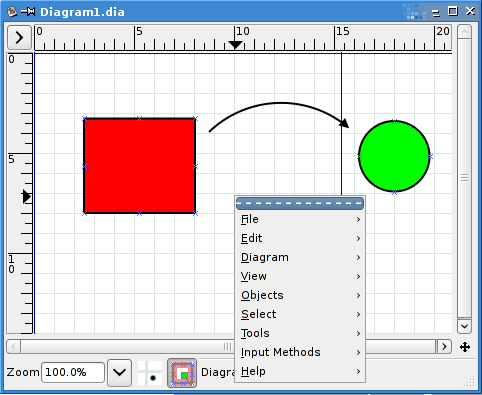
This is my biggest gripe with dia. For better or for worse, this is the kind of diagrams I draw in dia (below). I rarely use the in built stencils, because they all assume some specific kind of diagram other than what I need.

dia_filemenu.png

As it happens, one of the more useful functions in dia are the layers, when dealing with more complicated diagrams. To bring up the layer window, I have to right click on the canvas to get the main menu first. Why this menu isn't fixed at the top perplexes me (apparently it's possible to change this, but defaults are much more important than configuration options). Well, you might think what's the difference, either way it's just one click away. The difference is that when it's a fixed menu, it's always in the same place, it makes it easier to use, you locate items quicker visually.

A lot of useful things are in the main menu. Like alignment of objects. This is found in the Objects > Align submenu. Needless to say this is quite a pain to invoke more than a couple of times. This should probably be made into a palette window.

One thing I really like about dia is the number of different formats it can output. Most of my diagrams are pngs. This is called Export in dia. But to export my diagram (rather than save it in dia's own format), I need to choose File > Export from the menu. There is no keyboard shortcut for this action. If I'm tweaking my diagram to see if it looks good in a report, I have to do this export ritual several times. Awful.

Other quirks

And do you see that zoom control in the lower left corner? I can't change the zoom level with my mousewheel (like in the gimp). Bad.

In the above screenshot, if I wanted to place some object above the rectangle, a distance greater than what I see in the canvas, I have to scroll up. Except that the scrollbar doesn't seem to allow this, it seems to indicate that the canvas can't be larger than this. The mousewheel will actually scroll up, which is inconsistent with the scrollbar.

The Power of Nightmares: explaining terrorism

September 6th, 2007

I came across this really interesting program from 2004 produced by the BBC. The Power of Nightmares explains terrorism and indeed the current geopolitical climate in terms of the US neoconservatives' need to scare us in order to battle liberal values. Interestingly, the current radical Islamist movements are explained to stem from what was a similar movement to protect Arab states from corrupting Western influence.

The program is in three parts (180min), see them all on:

On the other hand, if you're going to be flying anytime soon, you might do better to skip this one, as it will infuriate you even further at all the bullshit you have to go through and have your toothpaste and scissors stolen.