Archive for 2003

Rob Dougan fuoriclasse

July 2nd, 2003

There is something so captivating about Rob Dougan's "Furious angels". The album is packed with quality tracks. I don't quite know how to account for the phenomenon, his vocals are questionable and if it wasn't for the magnifique tunes I wouldn't like it at all. But the clean, melodic tunes make it a big hit. I was first stunned by his blockbuster track from "Matrix reloaded", entitled "Chateau" and I still think it's his finest to date. But "Furious angels" carries more of the same, I see a strong influence of classical music (if I was more of a classical buff I would be able to recall the actual pieces) used to good effect. "Furious angels" - the title track carries that well known theme from "Matrix reloaded", coupled with Rob's vocals. It opens with a slow crescendo to include a slightly more spectacular vocal bit than Rob's own and finally builds up to disintegrate into a bunch of chaos.

"One and the same" opens quietly, and very pleasantly. Rob takes on a U2-like style as regards the vocals and I dare say his resemblance to Bono is noticeable.. Both a choir and an orchestra in the background fuels the track throughout.

Track list:

1. Prelude

2. Furious Angels

3. Will You Follow Me?

4. Left Me For Dead

5. I'm Not Driving Any More

6. Clubbed To Death

7. There's Only Me

8. Instrumental

9. Nothing At All

10. Born Yesterday

11. Speed Me Towards Death

12. Drinking Song

13. Pause

14. One And The Same (Coda)

15. Clubbed To Death 2

Fortunately, the entire album is available online for listening pleasure @ www.rob-dougan.com.

8/10

Minority Report: overrated, unrealistic

July 2nd, 2003

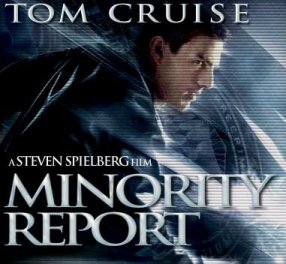
Minority Report Finally got around to seeing "Minority Report", I've had it on tape for a couple of months but never was in the mood to have a look at it. And I have to say I wasn't missing out on much. The vision of the future was somewhat interesting, the cars, the computer equipment, not to mention the advertising. Pretty much based on ideas scientists play around with these days I imagine.

I have a fundamental problem with the predicton of the future, it goes back to Greek mythology and the Oracle which made prophesies. It's been far too long since I read up on the subject, but there was a God to whom a son was born. The God went to the Oracle to hear about his son's future and learnt that his child would eventually kill him. He ordered for the son to be killed but he wasn't, he was adopted by a family. Then the son grew up to kill his father, the dictator, without knowing his relation to him. And that's a very superficial summary but the irony here is that hadn't the father gone to the Oracle and learnt the future, it wouldn't have been what it was. That's the core issue here, hearing the prophesy will alter the future from what it would be if you hadn't heard it. And "Minority Report" reiterates that concept in John's case, but not fully. John sees the future and learns he will kill a man whom he doesn't know. In the quest of learning what is supposed to happen and how, he fulfils the prophecy. Had he not known the prophecy, he would never made it happen. The man he doesn't know turns out to be the same who killed his son, and that almost drives him to kill, so far so good. But then he alters the future from what it's supposed to be. So here the author needs to make a choice, either the prophets do see the future or they don't. You cannot foretell the future and change its outcome both at the same time. The same goes for Lamar, but remember the case is not identical. Lamar hasn't been told he will kill John, but his mind is set on it. Meanwhile, the prophecy has been made and the future has been seen. And again, the prophecy is false, Lamar commits suicide. So what's it gonna be, do the cognitives actually see the future or don't they?

One way or another, I think there is a weak link between the whole futuristic aspect of this and the actual psychic proposition. What is so high tech about precrime? Not a thing. The whole concept is based on the fact that the cognitives have a gift of seeing the future, as in a God given talent, not science, they might as well live in the stoneage, there's nothing special about this day and age. And another thing, if this is 2050, we got retinal scanners in the subway, why are these men running around shooting 50-year-old guns? Doesn't it stand to reason that in 50 years we'll have far more sophisticated weapons, given the otherwise high technical advancement in the story? And what's with the crime scene around Danny's death? He's killed by Lamar in John's apartment and everyone just assumes John is guilty? If you got CSI and DNA evidence swingin' in 2003, how trivial must it then be to trace back the murder to Lamar 50 years down the road? And why doesn't John go blind? The eye doctor tells him about 100 times not to remove the bandaid prematurely, yet he does. Why doesn't he at least go blind on his left eye?

I guess the story is the weakest link and I'm a little surprised this picture got as much noise as it did. Well not by looking at the movie poster surely, Spielberg and Cruise. I certainly think Cruise was a little weak in this part, as regards Spielberg, I think the camera angles were poor on most occasions. Clearly one I could afford to miss.

I should mention the score is very poor, despite it being John Williams.

6/10

computer self-repair

July 1st, 2003

I stumbled upon a fascinating article in the June 2003 issue of Scientific American. I believe the vision set forth represents a much needed critical case study of today's situation, that being frequent breakdown of systems and poor reliability. Downtime is a much less significant problem to me than the actual restoration process which at times is a killer. "Self critical" systems should be the next step in the grand scheme of computing.

The project is labeled ROC for Recovery-Oriented Computing. The research team looks favorably to new concepts such as benchmarking the recovery time of a system, micro rebooting (that is restarting only subcomponents of a system rather than the whole system) and undo functions to trace the steps a system administrator would take.

rome pics added

June 30th, 2003

I finally got around to something I've been putting off for weeks, that being getting the Rome pics online finally. Most of them are raw copies of the originals, not even touched, the worst cases I hacked a bit with Photoshop.

extra terrestial life

June 29th, 2003

First of all, I'd like to dedicate this installment to Torkel, he's the one who got me into blogging in the first place, thanks to his own blog. Ie. it's his fault you're reading this now ;-)
A popular representation of extra terrestial existence It amazes me the kind of ideas people have about intelligence in outer space. For many it's hard to imagine we are alone on this tiny little planet, in an infinite (or not) universe, just us and there's noone anywhere. So they make up stories about aliens, who they are, what they look like and so on (apparently their ships are gigantic and in most cases silent). We like to picture them as similar to us, breathing air, looking all weird with various animal like features and we like to kick some alien butt too.

Well I got a beef with that, it's far too simplistic for my taste. The assumption is common for all speculation of that kind, ie. the human being is the center of the universe. Apparently, that is obvious to a lot of people, few dare question it. Why does it have to be so? Because all those theories assume that if indeed there is life in the universe, the human being can see it, communicate with it and why not destroy it. Ie. the human mind is at least equal, perhaps superior, to any other form of intelligence.

Let's take a radical step now, what if that is not the case? What if the human being, along with the human mind, is just a small element of a greater whole? If you think about it this way.. everything that we know stems from our reasoning. Our senses give us a base to explore the Earth. We employ them to do that, and every step from that very beginning all the way to modern time, is a chain of deductions, nothing more. All science is based on the information we first obtain through our senses. The periodic table is a list of chemical materials we believe cannot be split and make up the world we know, it's a result of our reasoning.

Time for that step now... What if the world we know is relative to a greater entity? What if our minds operate in some section of that entity and there are things we are not fit to understand? If we imagine this is the case, then it follows that we will never understand anything more than we now do. The term "dimension" is one we like to use. Time is the 4th dimension, no further dimensions are defined. What if extra terrestial life is to be found in other "dimensions"? Wouldn't that make more sense, imagine "life" is spread uniformly in the universe and our specific brand of life exist on Earth, but there are other life forms we don't know about, will never know about and even if we did, could never understand nor communicate with? We simply have no bridge into their world, their type of existence is completely abstract to us. Is that a less reasonable speculation?

To me that makes just as much sense, simply because of the explanation already given: our understanding of our own existence boils down to our mind. "It's all in your head" and that's exactly right. Imagine there is a world where concepts of time, quantity, memory etc (all fabrications of the human mind) are abstract.

The problem with this kind of reasoning is that it becomes very vague very quickly, ideas emanate which are hard to grasp, there are no firm definitions because very few assumptions are being made. I cannot say if the statement above makes any sense to anyone but me.

Ps. No, it's not "The Matrix", I've had these thoughts way before I knew about the movie, nor do they have anything to do with it. The closest movie I know to touch on the ideas I've put forth is "Contact", though it is egregiously boring.