Archive for 2007

because cheating is a lot more fun

February 24th, 2007

Unless you've lived your whole life under a rock, you've probably played a game or two. But did you ever cheat? Of course you did. :D

Whether it was on a computer, a console, a GameBoy, one of those electronic handhelds that only had one game, or any other kind of programmed game. Some people really really love games, I used to be one of those. Others like them, but never get really hooked. I remember there were kids who played a new game every week, they were constantly looking for new challenges. Then there were those who played the same games over and over. I loved games, but only some games, so I was in the latter category.

I think my all time favorite game was Championship Manager, which may seem somewhat strange, considering there were no fancy graphics, no animation, no interactive characters, and the game screens themselves didn't really look that amazing. But everything great in this game was in its depth, not on the surface. In fact, anyone who say me play it and had just walked into the room couldn't get what was so great about it. CM was a very popular game, though, not among the market winners by any means, but it had a super strong core following. And that's because it just didn't wear off, it didn't get old. Well, not until you'd played it for aaages.

First of all, CM is a simulation, so for it to be interesting you have to be interested in what it simulates. But if you are into it, and you have an imagination ( :P ), then you can play CM to explore pretty much any possible what-if scenario you could ever think of. It's like a meteorologist could add a new continent into his system and simulate the weather in Paris based on this new data. Well alright, but so what? There have always been a few football simulation games on the market, what makes CM so special? It's because, unlike those other games, CM seems realistic. The game engine works quite well, so most of the time you get the same kind of results that you would get in real life. It seems obvious that for a simulation to be worthwhile, it has to be able to simulate with a certain degree of credibility. But CM is the only game that has been able to achieve this, while providing great gameplay.

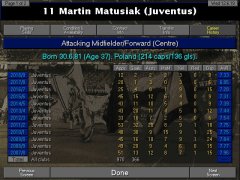
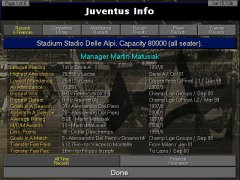
So, given this great game, what do you do with it? What do you aim for? How do you really like playing it? People have different taste, but to me the most exciting part of gaming was testing its limits. Once I mastered the game fairly well, I tried to do all kinds of things that I really wasn't supposed to do. :D Because *those* parts of the game were a bit like unexplored territory, you never knew what to expect. Most of the time the cut off points in games are very logical and mundane. Like if you play a car racing game and you try to steer your car outside of the track, most likely it will just bounce off an invisible wall, it won't crash, nothing "interesting" will happen. But exploring boundaries and trying to find things that few people had seen always seemed like fun to me. This is where CM comes in again, because exploring boundaries in CM was more fun than bouncing off invisible walls. The question was simply: in this simulation, if I create this state, what will happen? If I give my club a stadium of 500,000 seats and set the average attendance to capacity, will I become filthy rich from gate receipts? (The answer is yes. :D ) If I create a player with the youngest possible age, max out his stats and play the game long enough to see out his entire career, can he exceed 200 international apps? (The answer is yes. :D ) If I take over my hated rival club (usually Roma :devil: ), sell their entire first team, give all the youth players £100k/week contracts, can I bankrupt and relegate them in one season? (The answer is yes. :D )

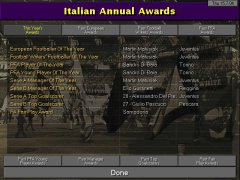
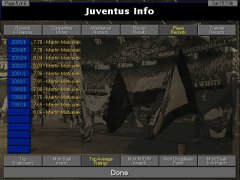
It is toying with reality, it is creating scenarios that would never happen, just because you happened to think of it. What helps this happen is cheating, of course. ;) Cheating is a shortcut to creating that situation you want to simulate. I was looking around my harddrive the other day and found a bunch of old screenshots from CM 97/98, the best release. The only screenshots from any game that have ever survived permanently. Looking over them now, I remember how many hours of thrill they represent. Imagine how much neglected homework!! :D
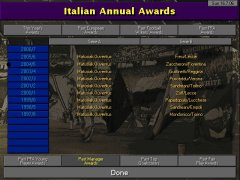
cm_managerawards.jpg cm_matusiak37years.jpg
cm_jackpot.jpg cm_clubinfo.jpg
cm_topaverageratings.jpg  

But what surprises me is the bashful attitude most people have toward cheating. Let's review the facts here. Gaming is all about entertainment, right? So whatever you can do to entertain yourself better would be good, right? So what's wrong with cheating? If you're in some kind of tournament competing against other gamers, then yes it would be unfair. But if you're just doing it for your own personal enjoyment, then condemning cheating makes no sense. The only argument you could make is that you're "cheating" the makers of the game, those who set the rules and boundaries of it. But all *they* did was make the game such that it would be the most fun for you to play, so if they knew you wanted to change something, and they thought they could get more sales this way, they would have. A game like CM depends on a certain correlation to real life. If you removed that limitation, the game would lose its value. If you could play with 11 strikers and win every match, it wouldn't be realistic, and it wouldn't be fun. So the fun in cheating lies in testing some those limits while still keeping the rest of them in a semi-realistic framework. Cheating is more fun.

that elusive free time

February 23rd, 2007

Interviews are a curious thing. You see that there's an interview with a person you find interesting and you're thinking "I'm gonna read this". I feel the thought process there is a little lacking. Even if it is an interesting person, you're not going to be dazzled by the answer to the question What's your favorite color?, or What book is on your nightstand?. Unless it's with an expert in color theory or a literary critic, but those people never get interviewed.

One question from How to conduct an interview that appears on page 7 in bold face with a big red ellipsis around it is What do you do in your spare time? Every interviewer asks this question. It's the epitome of "I've run out of crap to ask about", it gives you a chance to bounce back from the favorite color and end the interview on a high note.

Almost everyone gives the same answer to this question. "Free time? I wish I had some of that." Yep, no one has any free time. It almost makes your heart sting. There's no time for free time in our crazy, hectic lives. But *we* have free time. Those of us reading these interviews. I mean don't tell me that reading an interview is part of some planned activity.

Except it's not true. It's a big lie. It's what we say to make our lives seem more meaningful. "Between my career, my health club, my night classes of Japanese, my political activity and Saturdays at the soup kitchen, I barely have any time left for my family, let alone free time." Well I got news for you. Your health club? That's free time. Your political activism? Free time. Photography club? Free time. Company softball team? Free time.

It's all free time. Most people work, so having a job is not really optional. Taking care of your kids isn't either. But everything else is. Whether it's curling or curing cancer. Just because you planned in advanced what you're gonna do in that time doesn't mean you can't cancel in an instant if you wanted to, it's *your* time, *you* decide.

When I was a kid I didn't have as much free time as most kids. I had after school Polish classes once a week and music lessons once a week. That was a real hassle too, the violin teacher lived across town so I would have to take the bus from downtown up there, wait an hour until it was my lesson, have my lesson, have orchestra, then it took me an hour to cross town and get home again. My whole afternoon gone, I would get home at 8pm. I also used to do [organized] sports, never anything for a long time, but I played football for a year and a half, ju-jitsu for 2 years, volleyball for a year and then basketball for a year. I never really fit into organized sports, so I actually played a lot more sports "disorganized". Anyway, violin was a hassle, my lesson was only once a week, but I had to practice an hour everyday, and I didn't like practicing. Finally I quit violin after 5 years. That really freed up my time. Suddenly I felt like I had a lot more free time. That doesn't mean I spent it productively, though. More free time to play computer games, that's where it went.

But in both cases it was *my* time, so if you don't have *any* free time, that's because you've decided you don't want any. If you plan 7 different after school/work activities per week, then you're not interested in free time. Free time is for pragmatics. "We'll cross that bridge when we get to it." It's not for obsessive planners. Because it's really a matter of definition. If I played football in a club, I would call that my free time. "Yeah, that's what I fill my free time with." Or developing software, yep that's free time. If you don't want to call it that, that's up to you, but it is what it is.

idea: make systray behavior standard

February 22nd, 2007

I have akregator and amarok in the systray. Both are minimized, and when restored one covers the other because they occupy the same area on the screen.

  1. I'm looking at my desktop when I click on akregator, it appears.
  2. I click on amarok, it appears on top.
  3. I click on akregator, it appears on top.
  4. I click on akregator, it gets minimized, amarok appears.
  5. I click on amarok, it gets minimized, showing my desktop.

Akregator and amarok respond the same way to a single click, this makes them easy to use interchangeably, I can go from one to the other and both do the same thing. But not all applications behave like this, for instance some require double clicking to appear. If that's the case, I have to remember which one uses a click and which uses a double click.

Wouldn't it be nice if all applications had the same systray behavior? KDE and Gnome could set up the wiring and provide a default for this. Then an application could override this if it really needed to. :)

the cult of the leader

February 20th, 2007

I was watching some clips on Youtube and I stumbled upon some good old Apple clips among others. It's amazing how Youtube sucks you in, you're only looking for one specific thing but then you end up watching tons of "related" and "recommended" stuff. Oh well.

Anyway, it made me reflect on some of the biggest personalities in the IT industry. Not necessarily the most influential, but certainly the cult figures if you will, the billboard faces.

First up, Bill Gates. Bill is a deceptive figure in many ways, in interviews and talks he comes across as such a normal person, so much like any engineer. There's also something about this normality that gives him charisma, I have to say I find him quite a personable figure for some reason. Of course he stands at the head of a company that has built up a portfolio of shall we say practice we file under various degrees of "unethical". But still, when he talks about his visions for technology, it comes across as something a technically minded person would think about. And beyond that, being a superbly successful businessman, he seems very unassuming, very humble. The kind of guy you could talk to, and disagree with on many things, but also find agreement on many points.

In contrast, Steve Jobs just freaks me out. I don't know if you've seen one of those keynotes, but the whole thing is not unlike some religious cult. Steve's there speaking, with this strange light in his eyes, as he regards his minions and feels the power of his persona. When he speaks, he gets an immediate response, of cheers or boos (rarely), it's like a Gospel church.

And along with himself, the company image is so conceited as well. "I think you always had to be a little different to buy an Apple Computer. You had to think different about computers. I think you had to think really differently when you bought a Mac. And I think the people who do buy them do think differently. And they are the creative spirits in this world. They are the people who are not just out to get a job done, they're out to change the world." Btw, talk about the least creative company name ever.

Then there's Steve Ballmer. This guy is the creepiest company chief I've ever seen. I mean they actually made the guy from this old commercial head of the biggest company in the world, how insane is that? Ballmer has this odd quality to him that just makes him seem totally and completely unpredictable. Like a ticking time bomb and you never know when he's going to go off. It's basically the nut running the nut house. The chair throwing incident (unfortunately couldn't find the video) is really famous, but it doesn't stop there, he's just stark raving mad.

the passions of childhood

February 18th, 2007

Children are in a position of disadvantage, they are absolved of power. As a kid there aren't that many things in life you can really decide on, because your mandate keeps getting overruled by a higher office all the time. It would be nice to have some autonomy in this totalitarian regime, but in practice it takes a lot of negotiation and concessions. It's pretty fine diplomacy because of your great disadvantage, it's like Luxembourg negotiating with France. A kid would make a fine political adviser.

Of course, when you're a kid you deal with this everyday, all this is self evident. But people grow up and forget. When I was a kid, I vowed never to forget. Never to become one of those parents who don't understand kids and just pass arbitrary laws. Students are in this position too, they have no power. I always thought that if I ever became a teacher, I would remember what it was like to be a student.

Well, so far I haven't actually put those theories to the test, I'm neither a parent or a teacher. But sometimes I'm reminded of how my values have changed over the years. The other day I saw a couple of people standing in the street. One was holding a bike, the other was standing very close. Since they were far away and both wearing big coats, I couldn't make out what they were doing. "Is it a couple? Are they hugging?" The angle made it hard to see. "No, it's a father and a child sitting on the steering. But why are they just standing there? Oh of course, they're watching the crane!" There's some road work being done in my street these days, they've been digging and they even brought in a crane to help out.

It's hard to remember your values once they're no longer your values, you have to be reminded. One of my biggest moments in early life was operating a small digging machine in an amusement park. I have a picture of it, and it clearly shows how focused I was on what I was doing. When you see a kid, suddenly these things come back to you.