Archive for 2007

vowel multiplicity

February 12th, 2007

Dutch words love double vowels. We don't have that in Norwegian, we have the opposite - double consonants. When there's one, the preceding vowel is long, when there's two it's short.

hele - the whole

helle - to pour

The pronounciation is distinct.

In Dutch you have double vowels that sort of maybe sometimes are pronounced differently than single ones, but if so I can't tell. So to me it's like they pop up for no apparent reason. I have no clue when to expect them, it's a hassle. Or if I'm actually pronouncing it right.

hel - hell (and many more meanings)

heel - a whole

Maybe I misunderstood the meaning, but that's not the point. The point is that they sound the same to me. Now take a word like this.

helemaal - completely

How the frick am I supposed to know the multiplicity here? Double the first e, the second e, or maybe the a?

If you think it's just the last vowel that doubles.. :P

heelal - space

I remember my English teachers always told us it's fine whether we prefer the British or the American spelling, so long as we're consistent. Perhaps I could apply the same principle here? :redface:

planetary eyecandy

February 11th, 2007

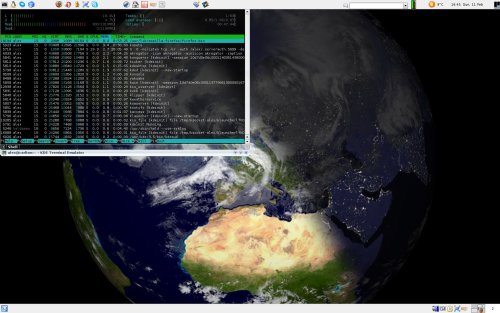
Eyecandy is somehow nicer when it serves some purpose aside from just looking pretty, wouldn't you say? Then it has the same kind of effect as a great car or fine architecture. "Wow, it's great. And it looks awesome." Otherwise the appearance on its own seems a bit shallow and pointless. Now for the demo, here's my newest wallpaper (click to see the fullsize hosted on deviantart):

we_call_it_planet_earth_by_numerodix.jpg

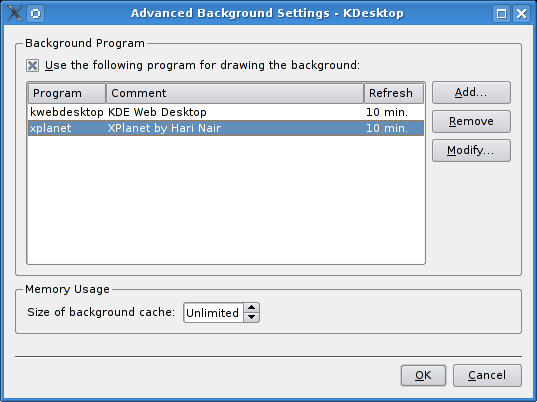
If you've ever thought that having one particular image on your desktop gets a bit dull, then this may be something for you. xplanet generates images of the Earth at set intervals (for example every 10 minutes) that shows the Earth roughly at this point in time. In addition, what I have here is cloud cover updated every 3 hours, so it's like a weather map. xplanet is phenomenally flexible, it can render multiple bodies at the same time (for example the Earth and the moon), it renders stars, it renders all the planets in the Solar System (yes, Pluto too) and many more bodies. What I have is a pretty standard configuration. So where to pick up the goodies? First, install xplanet (it's in portage :) ). Then if you run KDE, right click on the desktop and go into the config. On the Background tab, click Advanced Options and xplanet should appear in the list there.

xplanet_adv_opts.png

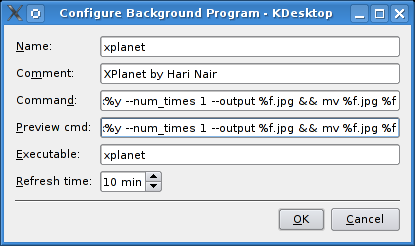
When you click Modify... xplanet will most likely have filled in the blanks for you, but otherwise something like this will do:

xplanet_params.png

The Preview cmd isn't really important, but for Command you could use:

xplanet -config ~/.xplanet.rc -radius 60 -latitude 52 -longitude 5 --geometry %xx%y --num_times 1 --output %f.jpg && mv %f.jpg %f

This will center the view on Utrecht more or less, but you can pick your own coordinates. Since we've supplied a configuration file, we have to create one.

$ echo -e "[earth]\ncloud_map=/tmp/.xplanet/clouds_2048.jpg" > ~/.xplanet.rc

Now we want to rig up a system that will download updates of the cloud map when they are available. We've already declared that they should be written to /tmp/.xplanet/clouds_2048.jpg, so let's create that path now.

$ mkdir -p /tmp/.xplanet

We'll use Michal Pasternak's python script for this. First save the file in /usr/local/bin, make it executable, then open it and edit this line:

defaultOutputFile = "/tmp/.xplanet/clouds_2048.jpg"

And finally we're going to use our friend cron to execute the script every hour:

$ crontab -e

And add this line:

0 * * * * python /usr/local/bin/download_clouds.py &>/dev/null

And that's it. Now you have a totally kickass wallpaper. :cool:

References

  1. Tomasz Karbownicki's original entry which explains how to do this in Gnome [pl]
  2. Kamil Baćkowski's follow-up entry on using xplanet in KDE [pl]
  3. xplanet website with tons of info and hacks

is "blogger" euphemism for "writer"?

February 9th, 2007

I recall "blogging" being born out of the first Content Management System (CMS) switched from being used to operate a whole website to being used by just one user. It may have come about in some other way, but that's not really important. What I'm driving at, though, is that in those days it was the most casual, uncommitted kind of writing/ranting, which noone took for anything else.

Of course there were people writing long before they started doing it with dynamic pages, just by composing static html and publishing it. But that's not blogging, blogging is closely tied to the idea that you have dynamic pages, which allow you to easily publish new content from anywhere, and allow you to receive comments. For anyone to create static html, there is a bit of a barrier to it, it almost seems like there should be a purpose to it. As such, html scribbling never was as widespread as blogging. Blogging made this so incredibly easy that people who had things to say, but never would even consider touching "the geeky stuff" were empowered. And it is so easy that you can effortlessly rant and rave without ever having to do any work to publish it or lay it out on a page. Consider that the way in how you use something impacts how (and for what) you use it. That's what blogging has changed.

But the status of the blogger has changed too, since then. Beyond the Atlantic, "the bloggers", as they are called by the media, have become a political entity with some influence. It's strange to hear about "the bloggers" in that context, because I'm "a blogger" too and I have nothing whatsoever to do with that. Blogs aren't about people's lives anymore, they are political influence, social commentary, artistic and commercial promotion, they are all kinds of things. Which is why you see stories like "Bloggers can make money, but most keep day jobs" and it looks out of context. Why wouldn't they? What is it that they do that is so valuable to society that it becomes their job? That's the thing, some people take blogging seriously. Which is something I've never done. :P

Does "blogging" actually mean something else now? Are bloggers actually writers with a lesser title? If you're a writer I can understand that it's your job.

the Paco standard for language proficiency

February 8th, 2007

If you've ever had to qualify for going to school abroad, you've probably had to take the silly TOEFL or IELTS language test. Or the silly equivalent for whatever language you need to prove yourself in.

Instead of taking those tests, wouldn't you rather boast about how many languages you speak? Sure, we all would. So the next time a guy asks you "do you speak a foreign language?" followed by "which?", you can say "yes".

That's why we're introducing the newest in language proficiency today: the Paco standard. That's right, Paco is officially certified by at least one qualified linguist and will determine just how good your cv is going to look. The Paco standard determines your proficiency in a given language by the ability to complete the given Paco. The more Pacos you can do, the higher your Paco level in that language.

Each Paco consists of a number (the level number), a popular name (what we all know this level by), and by a silly name (to translate between other proficiency standards).

Allow me to demonstrate how the Paco standard works with an example. What follows is the Paco level of proficiency for yours truly.

Paco 1 - did I hear something?
(would move out of the way of someone with a gun and yelling very loud)

Russian

Paco 2 - it's just like language x right?
(understanding the Emergency Exit sign)

Catalan, Portuguese, Brazilian Portuguese, Afrikaans-, Latin

Paco 3 - somo tehm words re no tspel correct
(one in five-ish in a sentence)

Spanish, Croatian, Serbian, Slovenian, Czech, Slovak+, German

Paco 4 - small subset, no grammar
(can read the sports section-ish)

Italian

Paco 5 - kinda sorta wanted to learn it once
(could speak three sentences in a row if my life depended on it)

French, Dutch

Paco 6 - heard it on the telly
(roughly got tone and grammar but have to translate words from a related language)

Swedish, Danish-, Nynorsk+

Paco 7 - omfg pwnage
(native)

Polish, Norwegian, English

UPDATE: The wonderful thing about Paco is that it's easy to compare notes. Here's how. Add up your Pacos to a total score. You get as many points for every Paco as the Paco level, so for example..

1 x Paco1 + 5 x Paco2 + 7 x Paco3 + 1 x Paco4 + 2 x Paco5 + 3 x Paco6 + 3 x Paco7 = 85 Paco
UPDATE2: Added German. What does it say of the language that my mind had repressed it?

vodafone: highway robbers

February 7th, 2007

When I moved to Holland I got myself a local cell phone subscription. I had no idea which one to choose so I went with the one that seemed to be fairly cheap, the vodafone prepaid deal. Prepaid means (in case the terminology is non standard) you buy cards with credits and only pay for what you spend.

I rarely use my phone at all, so it had been working fairly well for a while. (I noticed cell phones work the best when you don't use them.) Then I went to Poland for Christmas with about 20+ yuros of credits, and calling from inside the terminal to a Polish cell phone outside the building ate about 15 bucks in a minute and twenty seconds. I would have made the call much shorter, but the connection was rubbish. Then I noticed to my chagrin that sending an sms back to Holland cost me about a buck each. Insanity. In contrast, with my Norwegian cell phone subscription sending an sms from Barcelona to Holland cost me about 30 yurocents.

So when I got back I was on 5 yuros. And that's not a lot, so I was going to buy some credits, only to realize that they don't sell them anywhere anymore. In Albert Heijn they have a variety of cards for other providers (€10, €20, etc), but for Vodafone they only sell cards of 40 bucks. What the hell is that, a down payment on a house? I'll retire before I use up those credits.